
The soil is at the root of the problem…
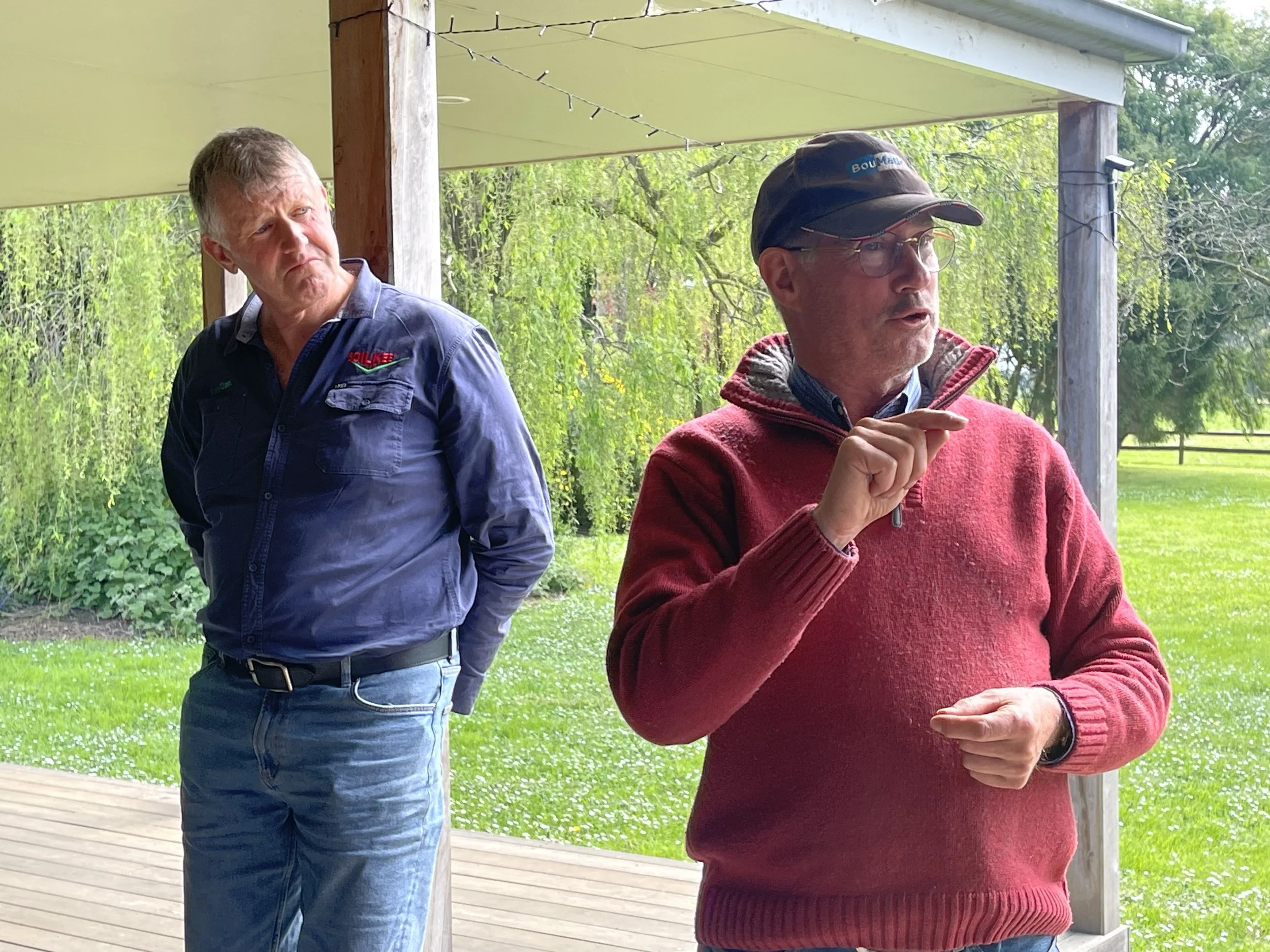
Two men with a passion for the soil, Niels Olsen (left), and industrial chemist Hamish Hunt explain why things need to change.
Niels Olsen potentially changed the game for global agriculture when he invented a machine that also made his earthworks and fertiliser businesses redundant.
His Hallora-based family operation – 16 kilometres out of Drouin in Victoria’s West Gippsland region – was stuck in a cycle of using more and more synthetic fertilisers for less and less results. Niels said in the end, something had to give. He started to question why their advisors gave no alternatives, outside of using more fertiliser at more cost.
“We were seeing a constant decline everywhere we cropped in the past, and it was supposed to be an improvement programme,” Niels said. “We were doing the right rotation, but we’re on difficult clay soil with a shallow sandy topsoil. Even the gum trees struggle here. We were using three or four times more synthetic fertiliser than the neighbours at one point.
“We would grow a great crop under that system, but at what cost? Then one year, we had a fertiliser challenge, and it was a bit of a slap in the face for me. I thought I better learn a bit more about this.”
Listen and learn
As he gathered intel – teamed with his soaring frustration levels from trying other methods – Niels decided to chart a deeply different path into regenerative agriculture. It wasn’t popular at the time, and many watched from the sidelines with more than a little cynicism.
Yet Niels is now proof that necessity is indeed the mother of invention. He engineered a new reality for the industry in the form of a revolutionary oversower, Soilkee®. This machine features several critical differences, which is giving others – and the future of sustainable agriculture – hope.
Soilkee works by cultivating a narrow seed bed – disturbing less than 20% of the existing pasture. The rotary blade’s spinning action creates a “green manure compost” that naturally activates soil fungi, microbes and earth-worm populations – all of which are the foundation of soil health and productivity.
Annual crops are sown into perennial pastures. At the same time, the renovator provides a natural fertilising effect by stimulating the soil’s microbiology.
The Soilkee machine is patented in 40 countries, and the farm-based business includes Niels’ wife, Marja, and three sons, Shane 31, Jamie, 29, and Shaun, 26.
Tested on his own farm
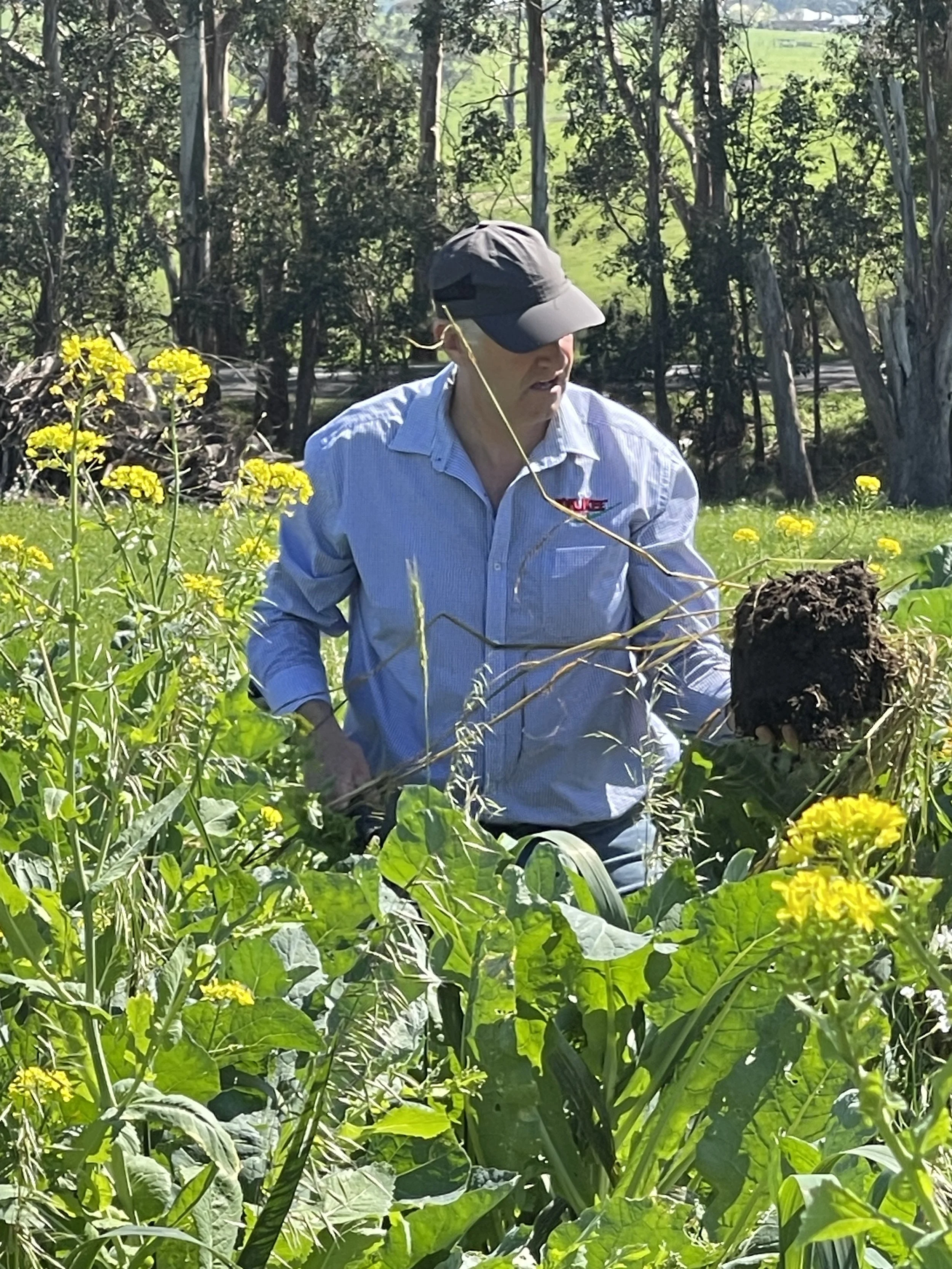
Niels shows what they have been able to achieve on their farm in Victoria.
The family’s farm was the first canvas for Soilkee to showcase what it could do. The Olsens’ farm had 85mm of topsoil when they began using Soilkee, and is now averaging 250mm over the whole farm – with peaks of 350mm. Niels estimated that their pasture holds on for a month longer than that of their neighbours, and if they get 40mm of rain in the middle of summer, their soils can absorb and use it, instead of it running off and being wasted.
Niels said they are finding their clients’ top soils generally cumulatively improve at a rate of 1-2mm additional depth a year. Ten years into the business, Niels has had plenty of time to watch, try, and learn. He is confident that Soilkee is part of agriculture’s resurrection.
“It’s about habits,” Niels said. “People will do the same thing until it doesn’t work anymore. Then they stop and sell up. And someone buys it and has a new point of reference, and they farm for that. It has shown me how narrow the human mind can be.
“We worked out you don’t really need all that fertiliser. Everything is in the soil, it’s just not available under conventional agricultural systems. We just had to make the biology available. Multi-species is also key because we’re feeding the biology, and the biology does the mining for us. Some of that mining can go a long way down into the soil - we’re talking metres.”
Niels quickly noticed under the new regime that with more ground cover, the soil was able to withstand and hold moisture and stay cooler on the hotter days, and that the cattle favoured the regenerative pasture over conventional pasture (before they switched the whole operation to regenerative agriculture).
“With the Soilkee, our pasture holds on for at least a month longer than it used to in the summer. And, if we get 40mm of rain in the middle of summer, we can use 100% of it because it stays in the soil. At the end of November there is consistent moisture all the way to the bottom of our pastures,” Niels said.
In an independent replicated trial, which was run over one year (in nine rotationally grazed paddocks on three farms funded by Commercialisation Australia), Soilkee showed how it could unlock soil function.
Truth in numbers
The trial showed evidence that Soilkee triggered regenerative soil function, improved soil structure and built soil carbon through carbon sequestration, which in turn increases the water-holding capacity and both presence and availability of nutrients.
The results included:
· Soil carbon increased from 3.7% to 4.6%
· Plant-available nitrogen increased 122%
· Plant-available phosphorus increased 34%
· Plant-available sulphur increased 51%
· Dry matter up to 30% increase
· Crude protein 13%-45% increase
Niels and his family are now busy manufacturing the Soilkee machines on their property for a growing wave of farmers ready to tap into another way.
“There is a lot of interest coming along now – partly driven by the sheer price of nitrogen and phosphorus – and there has been opportunity created by those price points for regenerative agriculture. The landscape is also drying up under conventional agriculture, and Soilkee pastures do stand out because they are greener for longer.”
Soilkee has emerged from the need of one Victorian family.
It now offers a way forward for everyone.

